April 28, 2011

Don’t Blame Oil Companies at the Pump


Many of you may have noticed that the prices at gas pumps are well above four dollars per gallon these days.  While oil companies may be raking in multibillion-dollar profits, they are not the source to blame.  Instead, we need to blame ourselves.

Costs of fuel are a reflection of global demand.  There is a limited amount of gasoline and other petroleum products that are produced every day, so when individuals increase their needs for energy, prices increase based on simple laws of economics.  The war in Iraq has caused for declines in oil production over the past couple of years, which in combination with the struggling production issues in a few other countries, has led to lesser amount of petroleum available per day.  The growing industrial economies of China and India have also established more demand for fuel, and with America continuing with its uninhibited desires for oil there is not enough to go around without affecting pricing.

The price per gallon that we pay every time we decide to refuel our car is composed of a variety of costs and fees, some of which are not even imposed by the oil companies.  Crude oil accounts for over half the cost of gasoline, obviously because it is the main resource necessary for the product.  On the other hand, refinery costs, taxes, and minor expenditures account for the remaining factors that affect prices.  The refining process converts crude oil into usable petroleum commodities, but only accounts for a small margin of profit for oil giants.  On the other hand, federal taxation makes up nearly 20 percent of the cost for gasoline, something that helps with government budgeting but simply acts as another tariff on the general population because, let’s face it, almost everyone uses a car in some form or another.

Exxon-Mobile recently released their quarterly profit estimates at a staggering 11 billion dollars.  While some would scoff and claim that there is no way oil companies are not making massive amounts of money off of gasoline, this is a reflection of the profit scaling that occurs with land speculation.  These companies survey land and potential oil fields with the idea of making investments that break even if oil prices are approximately $25 per barrel.  Considering the millions of barrels that are produced a day, these are very costly.  However, crude oil is currently trading at nearly $113 per barrel, meaning there is an $88 margin of profit per barrel on their investment.  This accounts for the extremely high profits that oil companies are capable of producing, not the prices charged at your local pump.

If there is any way to realistically make the price of a limited commodity decrease, it is to slowly reduce the taxation of it.  This proves a challenge considering these tariffs greatly affect the budget and effectiveness of the federal government in carrying out policy decisions.  If anything, this indicates that petroleum prices will only continue to rise over time.  At which point will we say, “Enough is enough” and begin to seek out energy alternatives that to a source that our entire societal structure has fixated itself upon.

Only time will tell.

April 23, 2011

Too Big to Fail


In January of 2008, Bank of America announced their offer to purchase Countrywide Financial, the largest mortgage lender in the country.  With the fall of a multitude of lending firms, the federal government feared the imminent collapse of mortgage lenders nationwide, and through agreements and coercion, is rumored to have convinced Bank of America to acquire Countrywide as a subsidiary.  This merger and acquisition deal brought significant debt to Bank of America’s front door in the form junk bonds and mortgage-backed securities that were created through subprime lending, but also provided a massive client base and network for future loans, investments, and financial products.  This prevented the collapse of mortgage lending for many homeowners throughout the nation and also gave Bank of America leverage and support from the federal government in case financials took a turn for the worse.  Now, Bank of America stands to become one of the largest, most successful companies in existence.

In addition to the acquisition of Countrywide Financial, Bank of America also moved to expand their banking empire through purchasing the troubled Merrill Lynch, the world’s largest brokerage and a premier wealth management firm.  The acquisition of these two massive businesses makes Bank of America the largest U.S. banks in terms of assets under management, offering “everything from fixed-income trading to credit card lending,” further providing them influence with the federal government.  At the time, the imminent threat of a collapsing economy made the bank an invaluable asset to the federal government; its failure would mean financial distress for millions upon millions of Americans.

When the financial distress began to affect major corporations during the crisis, the federal government made it imperative to keep Bank of America afloat.  This also extends to the current day, even though most major issues that created the financial crisis have been absolved.  One of the larger controversial issues was the allocation of taxpayer money to banks to give them enough capital to survive the economic depression, also known as the Troubled Asset Relief Program, or TARP.  Bank of America received 45 billion dollars in protection for acquired debt and “troubled assets” such as Merrill Lynch and Countrywide. 

Today it was announced that Bank of America was successful in winning a dismissal from a lawsuit seeking reparations from damages wrought by mortgage-backed securities sold through Countrywide prior to its acquisition.  This allows for the avoidance of a large settlement and continues to permit for Bank of America to minimize the issues brought on by its purchases, slipping through loopholes and gaining the necessary government support to return the business and the economy to the status quo.

With the fading pseudo-protection of the federal government and enormous growth of Bank of America through the duration of the financial crisis, they stand to post ridiculous monetary gains once their subsidiaries are completely recovered.  They now act as one of the nation’s largest lenders, a considerable firm in investment banking, and the largest wealth manager.  Seeing as they have a hand in essentially all necessary financial processes that take place in the market, the company’s stock valuation can only increase in the future.  Dramatically.

April 11, 2011

Thinking Apple? Think Again


From the standpoint of a long-term investor, Apple has provided some excellent returns in the technology sector in comparison to all of its major competitors.  AAPL, over a 5-year period, has provided investors with returns of nearly 405% off their principle investment.  These gains have come from market-dominating products such as the MP3 music player, the iPod, to the innovative iPhone, one of the first all-inclusive touch screen smart phones.  With so many groundbreaking accomplishments in the past couple years, investors might think that maintaining their shares of AAPL stock could provide a lucrative opportunity to further increase their wealth.  Given the multitude of issues that have recently plagued the technology giant, I am here to tell you otherwise.

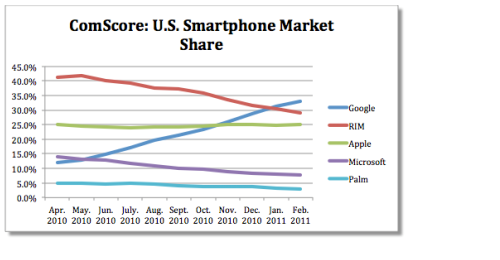
On of Apple’s most successful products, the iPhone, has recently faltered concerning sales and demand.  Since the release of the intuitive smart phone, the product has only been available on the AT&T communication network.  In order to increase profits on their product, Apple expanded their contractual agreements to include a major competitor, Verizon Wireless, in selling the phone.  Amidst extensive hype and anticipation, Verizon iPhone sales were relatively underwhelming in comparison to steady AT&T sales.  While past releases were met with massive lines on opening day, none were apparent on the new release for Verizon.  In addition to the uneventful release of the iPhone on the Verizon network, the phone has maintained a steady market share with little increase or decrease over the past year while phones operating on Android (Google) software continue to increase in demand.

The iPad 2 is another issue that may hinder the future success of Apple.  While the company purported exceptional sales for the first version of the tablet computer, sales numbers for the second edition have not been released.  This is unusual for Apple, as with prior products they have been quick to release sales numbers to prove the success of their innovative products.  The secondary issue for iPad 2 is that it continues to lack the computing power of many laptop and desktop computers that are priced competitively.  While it may appear trendy and convenient in terms of portability, its lack of performance and operation of advanced computer programs is a glaring issue that remains to be fixed.  Without a solution, the novelty of this product may soon fade, leaving Apple with significant production losses if sales decline.

The last glaring issue that threatens the valuation of AAPL stock is the health of its CEO, Steve Jobs.  Over the past three years, Jobs has twice left the company on leaves of absence due to his battle with a rare form of pancreatic cancer.  Jobs is cited to be the revolutionary mind behind the back-to-back successful products, meaning that any issues that take Jobs out of the picture will significantly damage the innovation that Apple is currently known for.  If Steve Jobs left permanently, stock values would diminish quickly as investors would lose faith in the ability of establishing an equal replacement, undoing five years of constant success.

For investors, this acts as a warning.  One should take in the consideration of these issues: recent Apple products are not as successful as they once were and the health of the centerpiece of the company, Steve Jobs, remains a question mark.  A wise investor might reduce their shareholding in Apple in order to reduce the risk of the inevitable downturn in APPL.

April 6, 2011

More Bang for Your Buck


Last year, British Petroleum (BP) came under extreme international scrutiny when one of their oilrigs, the Deepwater Horizon, exploded in the Gulf of Mexico.  This incident led the rupture of a major oil reserve, which incidentally spread toxic oil throughout and along the coast of the Gulf as well as southern North America.  This not only devastated wildlife, but also additionally damaged the local fishing and tourism industries.  While all of this occurred, CEOs were given additional monetary compensation in response to these damages.

Transocean, who owned the Deepwater Horizon, rented out the offshore drilling platform to British Petroleum.  They oversaw daily operations ranging from the drilling processes and procedures to security measures necessary for protecting the safety of their employees.  This obviously was unsuccessful, as eleven employees were killed in the blast that destroyed the rig.  Now, in response to having a “best year in safety performance in [the] company’s history,” Transocean’s Board of Directors believes that they should award their executive officers with lucrative compensation packages such as $200,000 base salary increases and $300,000 payment bonuses. 

All of this simply for doing their job.

Employee safety on company oilrigs should be a valued standard.  This is not something that simply happens because executives put greater effort into ensuring that specific safety measures are followed to the letter.  One of the biggest controversies concerning the Transocean platform explosion was that numerous warnings were told to be ignored by workers, something which both BP and Transocean are blamed for.  Transocean executives are now not only receiving unnecessary salary compensation for doing little but fulfilling their position obligations, but are rewarded for their connection and involvement in the destruction of the Deepwater Horizon.

Evidently, executive officers of Transocean quickly realized that they were not going to be able to keep their salary bonuses.  The officers were quick to state money awarded by the Board of Directors was focused towards the fund supporting the eleven families devastated by the destruction of the offshore drilling platform.  While this was likely due to social pressures from both internal and external forces, it indicates the acknowledgement of the negative stereotypes of “big business”:  allowing for individuals to receive compensation with little or no merit.

Executives are often criticized for their exceptionally high salaries and bonus opportunities.  This is argued as reasonable considering these individuals are susceptible to extensive criticism from the public and are responsible for making decisions that affect an entire company.  However, with the acceptance of these monetary rewards, the Transocean officers illustrated how people can receive ridiculous compensation for doing nothing more than what is and should be a baseline standard in performance. Transocean and the executive officers should be ashamed for further perpetuating the assumption that high-ranking officers are unjustly rewarded for their contributions to a company.  Shame on them.