Showing posts with label Public Square. Show all posts

April 28, 2011

Don’t Blame Oil Companies at the Pump


Many of you may have noticed that the prices at gas pumps are well above four dollars per gallon these days.  While oil companies may be raking in multibillion-dollar profits, they are not the source to blame.  Instead, we need to blame ourselves.

Costs of fuel are a reflection of global demand.  There is a limited amount of gasoline and other petroleum products that are produced every day, so when individuals increase their needs for energy, prices increase based on simple laws of economics.  The war in Iraq has caused for declines in oil production over the past couple of years, which in combination with the struggling production issues in a few other countries, has led to lesser amount of petroleum available per day.  The growing industrial economies of China and India have also established more demand for fuel, and with America continuing with its uninhibited desires for oil there is not enough to go around without affecting pricing.

The price per gallon that we pay every time we decide to refuel our car is composed of a variety of costs and fees, some of which are not even imposed by the oil companies.  Crude oil accounts for over half the cost of gasoline, obviously because it is the main resource necessary for the product.  On the other hand, refinery costs, taxes, and minor expenditures account for the remaining factors that affect prices.  The refining process converts crude oil into usable petroleum commodities, but only accounts for a small margin of profit for oil giants.  On the other hand, federal taxation makes up nearly 20 percent of the cost for gasoline, something that helps with government budgeting but simply acts as another tariff on the general population because, let’s face it, almost everyone uses a car in some form or another.

Exxon-Mobile recently released their quarterly profit estimates at a staggering 11 billion dollars.  While some would scoff and claim that there is no way oil companies are not making massive amounts of money off of gasoline, this is a reflection of the profit scaling that occurs with land speculation.  These companies survey land and potential oil fields with the idea of making investments that break even if oil prices are approximately $25 per barrel.  Considering the millions of barrels that are produced a day, these are very costly.  However, crude oil is currently trading at nearly $113 per barrel, meaning there is an $88 margin of profit per barrel on their investment.  This accounts for the extremely high profits that oil companies are capable of producing, not the prices charged at your local pump.

If there is any way to realistically make the price of a limited commodity decrease, it is to slowly reduce the taxation of it.  This proves a challenge considering these tariffs greatly affect the budget and effectiveness of the federal government in carrying out policy decisions.  If anything, this indicates that petroleum prices will only continue to rise over time.  At which point will we say, “Enough is enough” and begin to seek out energy alternatives that to a source that our entire societal structure has fixated itself upon.

Only time will tell.

April 23, 2011

Too Big to Fail


In January of 2008, Bank of America announced their offer to purchase Countrywide Financial, the largest mortgage lender in the country.  With the fall of a multitude of lending firms, the federal government feared the imminent collapse of mortgage lenders nationwide, and through agreements and coercion, is rumored to have convinced Bank of America to acquire Countrywide as a subsidiary.  This merger and acquisition deal brought significant debt to Bank of America’s front door in the form junk bonds and mortgage-backed securities that were created through subprime lending, but also provided a massive client base and network for future loans, investments, and financial products.  This prevented the collapse of mortgage lending for many homeowners throughout the nation and also gave Bank of America leverage and support from the federal government in case financials took a turn for the worse.  Now, Bank of America stands to become one of the largest, most successful companies in existence.

In addition to the acquisition of Countrywide Financial, Bank of America also moved to expand their banking empire through purchasing the troubled Merrill Lynch, the world’s largest brokerage and a premier wealth management firm.  The acquisition of these two massive businesses makes Bank of America the largest U.S. banks in terms of assets under management, offering “everything from fixed-income trading to credit card lending,” further providing them influence with the federal government.  At the time, the imminent threat of a collapsing economy made the bank an invaluable asset to the federal government; its failure would mean financial distress for millions upon millions of Americans.

When the financial distress began to affect major corporations during the crisis, the federal government made it imperative to keep Bank of America afloat.  This also extends to the current day, even though most major issues that created the financial crisis have been absolved.  One of the larger controversial issues was the allocation of taxpayer money to banks to give them enough capital to survive the economic depression, also known as the Troubled Asset Relief Program, or TARP.  Bank of America received 45 billion dollars in protection for acquired debt and “troubled assets” such as Merrill Lynch and Countrywide. 

Today it was announced that Bank of America was successful in winning a dismissal from a lawsuit seeking reparations from damages wrought by mortgage-backed securities sold through Countrywide prior to its acquisition.  This allows for the avoidance of a large settlement and continues to permit for Bank of America to minimize the issues brought on by its purchases, slipping through loopholes and gaining the necessary government support to return the business and the economy to the status quo.

With the fading pseudo-protection of the federal government and enormous growth of Bank of America through the duration of the financial crisis, they stand to post ridiculous monetary gains once their subsidiaries are completely recovered.  They now act as one of the nation’s largest lenders, a considerable firm in investment banking, and the largest wealth manager.  Seeing as they have a hand in essentially all necessary financial processes that take place in the market, the company’s stock valuation can only increase in the future.  Dramatically.

April 11, 2011

Thinking Apple? Think Again


From the standpoint of a long-term investor, Apple has provided some excellent returns in the technology sector in comparison to all of its major competitors.  AAPL, over a 5-year period, has provided investors with returns of nearly 405% off their principle investment.  These gains have come from market-dominating products such as the MP3 music player, the iPod, to the innovative iPhone, one of the first all-inclusive touch screen smart phones.  With so many groundbreaking accomplishments in the past couple years, investors might think that maintaining their shares of AAPL stock could provide a lucrative opportunity to further increase their wealth.  Given the multitude of issues that have recently plagued the technology giant, I am here to tell you otherwise.

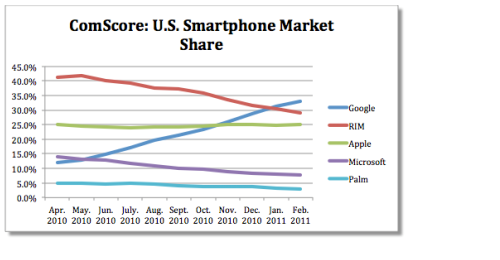
On of Apple’s most successful products, the iPhone, has recently faltered concerning sales and demand.  Since the release of the intuitive smart phone, the product has only been available on the AT&T communication network.  In order to increase profits on their product, Apple expanded their contractual agreements to include a major competitor, Verizon Wireless, in selling the phone.  Amidst extensive hype and anticipation, Verizon iPhone sales were relatively underwhelming in comparison to steady AT&T sales.  While past releases were met with massive lines on opening day, none were apparent on the new release for Verizon.  In addition to the uneventful release of the iPhone on the Verizon network, the phone has maintained a steady market share with little increase or decrease over the past year while phones operating on Android (Google) software continue to increase in demand.

The iPad 2 is another issue that may hinder the future success of Apple.  While the company purported exceptional sales for the first version of the tablet computer, sales numbers for the second edition have not been released.  This is unusual for Apple, as with prior products they have been quick to release sales numbers to prove the success of their innovative products.  The secondary issue for iPad 2 is that it continues to lack the computing power of many laptop and desktop computers that are priced competitively.  While it may appear trendy and convenient in terms of portability, its lack of performance and operation of advanced computer programs is a glaring issue that remains to be fixed.  Without a solution, the novelty of this product may soon fade, leaving Apple with significant production losses if sales decline.

The last glaring issue that threatens the valuation of AAPL stock is the health of its CEO, Steve Jobs.  Over the past three years, Jobs has twice left the company on leaves of absence due to his battle with a rare form of pancreatic cancer.  Jobs is cited to be the revolutionary mind behind the back-to-back successful products, meaning that any issues that take Jobs out of the picture will significantly damage the innovation that Apple is currently known for.  If Steve Jobs left permanently, stock values would diminish quickly as investors would lose faith in the ability of establishing an equal replacement, undoing five years of constant success.

For investors, this acts as a warning.  One should take in the consideration of these issues: recent Apple products are not as successful as they once were and the health of the centerpiece of the company, Steve Jobs, remains a question mark.  A wise investor might reduce their shareholding in Apple in order to reduce the risk of the inevitable downturn in APPL.

April 6, 2011

More Bang for Your Buck


Last year, British Petroleum (BP) came under extreme international scrutiny when one of their oilrigs, the Deepwater Horizon, exploded in the Gulf of Mexico.  This incident led the rupture of a major oil reserve, which incidentally spread toxic oil throughout and along the coast of the Gulf as well as southern North America.  This not only devastated wildlife, but also additionally damaged the local fishing and tourism industries.  While all of this occurred, CEOs were given additional monetary compensation in response to these damages.

Transocean, who owned the Deepwater Horizon, rented out the offshore drilling platform to British Petroleum.  They oversaw daily operations ranging from the drilling processes and procedures to security measures necessary for protecting the safety of their employees.  This obviously was unsuccessful, as eleven employees were killed in the blast that destroyed the rig.  Now, in response to having a “best year in safety performance in [the] company’s history,” Transocean’s Board of Directors believes that they should award their executive officers with lucrative compensation packages such as $200,000 base salary increases and $300,000 payment bonuses. 

All of this simply for doing their job.

Employee safety on company oilrigs should be a valued standard.  This is not something that simply happens because executives put greater effort into ensuring that specific safety measures are followed to the letter.  One of the biggest controversies concerning the Transocean platform explosion was that numerous warnings were told to be ignored by workers, something which both BP and Transocean are blamed for.  Transocean executives are now not only receiving unnecessary salary compensation for doing little but fulfilling their position obligations, but are rewarded for their connection and involvement in the destruction of the Deepwater Horizon.

Evidently, executive officers of Transocean quickly realized that they were not going to be able to keep their salary bonuses.  The officers were quick to state money awarded by the Board of Directors was focused towards the fund supporting the eleven families devastated by the destruction of the offshore drilling platform.  While this was likely due to social pressures from both internal and external forces, it indicates the acknowledgement of the negative stereotypes of “big business”:  allowing for individuals to receive compensation with little or no merit.

Executives are often criticized for their exceptionally high salaries and bonus opportunities.  This is argued as reasonable considering these individuals are susceptible to extensive criticism from the public and are responsible for making decisions that affect an entire company.  However, with the acceptance of these monetary rewards, the Transocean officers illustrated how people can receive ridiculous compensation for doing nothing more than what is and should be a baseline standard in performance. Transocean and the executive officers should be ashamed for further perpetuating the assumption that high-ranking officers are unjustly rewarded for their contributions to a company.  Shame on them.

March 23, 2011

Why Bankers Make Bank


Corporate executive officers have long been known to receive excessive amounts of monetary compensation in their positions of power, but where else are salary figures rampantly out of control?  John Rolfe and Peter Troobe’s insightful novel, Monkey Business, provides an inside’s look to the business practices and lives of employees within investment banks.  These firms are known for the massive amounts of money they pay their employees.  First year analysts, the entry-level investment banking position, commonly receive upwards of 120,000 dollars in full compensation packages.  It is common knowledge that people feel Wall Street is overpaid, but Monkey Business proves why such monetary payment is appropriate.

Investment banks specialize in connecting companies in search for capital with numerous wealthy investors all across the world.  They do this through analyzing the cash flows, projects, and operations of a company, which culminates into the development of a pitch book.  These “pitch books” are the bread and butter of investment banks.  Analysts will make hundreds of elaborate and lengthy pitch books on the evaluation of companies to give to associates and upper management only to have a handful actually presented to investors.  Because many things in the investment world are time sensitive, this consistently leads to “all-nighters” at the office in addition to the already grueling 100 to 120-hour workweeks that flow into the weekend.

Once the investment bank decides that they have a company worth pitching to investors, they have a group employees go on the “road show.”  This includes traveling to two cities a day that can be hundreds of miles apart.  The road show can last for a couple weeks, but is essential for distributing the investment opportunity that the firm is promoting to wealthy individuals or companies.  Once again, however, the low-level bank employees are forced on these treacherous travel schedules that span vastly different time zones with little extravagance or rest.

The results produced from extensive travels allow for investment banks to generate large revenues when providing initial public offerings or aiding in seasoned equity offerings.  In return, employees are handsomely rewarded for their diligence.  However, their costs include possessing social lives outside of work, the possibility to raise a family, and simple freedoms and luxuries that the typical employee enjoys.  This is a result of being constantly at risk of receiving a call, no matter the time or day, that requires for them to come to the office to complete work on a project.

Considering this form of activity is consistent even in upper levels of management, it should not be surprising that investment banks offer such high salaries.  While people may complain, they remain an essential middleman in providing financial support companies, something that affects all public firms and markets.  Monkey Business notes that for investment banks to create interest in such grueling workloads, they must provide lucrative compensation packages for people to feel as though the ends justify means.  So while critics may feel as though these extravagant salaries are unwarranted, it allows for investment banks to remain operational with willing employees that keep the gears of the economy functioning smoothly.

March 16, 2011

One Man’s Loss is Another Man’s Gain (Op-Ed)


Japan has just undergone one of the worst natural disasters in recent history, yet the price of their currency is skyrocketing.  Homes and communities are in complete disrepair, but national currency trading is reporting that the yen is exchanging for higher sums in comparison to previous weeks.

This must mean that the Japanese are inherently becoming wealthier as a result of this catastrophe, right?  Wrong, it illustrates the effects of fear and speculation.  While many individuals see these damages as devastating to the Japanese and world economy, there is a silver lining: an excellent period to short the value of the yen and earn wealth beyond your imagination.

As a result of the recent 8.9 magnitude earthquake and tsunami that struck Japan, the country is looking at damages approximating 200 billion dollars in rebuilding costs, excluding any insurance claims for benefits.  Because the Japanese government is facing such massive expenditures, they are forced to sell off reserves of foreign currencies in exchange for yen to pay for reconstruction expenses.  Those in possession of yen will ask for greater amounts of foreign currency per unit, which has since acted as the culprit for driving up the value of the yen.  When there is a limited supply, greater demand always causes for prices to increase.

Unfortunately, this appreciation of the yen is not stable.  The growth in the asking price for yen is artificial because if the price of yen rises indefinitely, Japan faces extreme inflation and the inability to repurchase their own currency.  Without any yen they cannot pay Japanese workers, which means they either resort to printing new money or converting to a new currency, both of which signify terrible economic stability and imminent collapse.  The collapse of one economy is devastating to global markets overall, and thus it is likely that a international governing body such as the G7 financial advisory group will make agreements in the coming days to limit the growth of the yen.  This is not the only step they will take either.  To ensure that the Japanese economy grows quickly from the ravages of this “perfect storm,” they will likely make moves to depreciate and stabilize the value of the yen so that the Japanese government can acquire as much domestic currency as possible.

The investment opportunities in Japan act as a significant upside to the current tragedies taking place.  With the proper investing technique, you could become tremendously wealthy off of the quick appreciation of yen prices and a strong likelihood for global intervention to qualm this accelerated growth.  This technique is known as shorting.  When someone “shorts” an investment such as currency, they borrow and sell a certain amount of currency at its current trading price under the assumption that they will return the amount borrowed after a period of time.  If I had the proper amount of money to invest, I would short as much yen as possible at its high price knowing that once the currency depreciates, I can purchase and return the amount borrowed and retain substantial profits.  The more money that you have to invest, they greater you have to gain.

While Japan is undoubtedly suffering one of the worst possible crises, the greatest times for earning profitable investments are when others face negative situations.  While this may seem insensitive to their plight, the world continues to revolve regardless of the situations of others.  If you do not take advantage of the situation, then some else will.  Would you prefer to “get rich” at the expense of others and possibly your own reputation?  What will others think?  Is it worthwhile?

I say yes.

March 12, 2011

Quit the Compensation? (Op-Ed)


Week after week we watch CEOs get paid millions of dollars in compensation for running their companies into the ground.  Many people are critical of executive compensation since banks began filing for bankruptcy in the beginning of the 2008 recession.  CEOs were given multi-million dollar parachute compensation packages while their companies and associated markets fell into pieces.

Congratulations!  Not only are they rewarded for poorly managing their companies, but they also do so at the expense of their investors.  In reality, these immense bonuses are typically given on a performance basis, but some critics are calling for executive compensation take the form of higher salaries rather than bonuses.

I think otherwise.

Recently, Chief Executive Officer Richard Waugh from the Bank of Nova Scotia was awarded $10.9 million dollars in compensation after the bank posted record profits.  This brings up controversy once again surrounding executive compensation.  Why should these officers get paid so much?  What are they doing that warrants receiving millions upon millions of dollars?  Critics such as the Institute for Policy Studies suggest that there are multiple repercussions for excessive executive pay, while others believe that the companies that produce the most consistent earnings are those that pay their CEOs a fixed salary over the entirety of the year.

The Institute for Policy Studies claims that the average employee is discouraged with their pay structure when they see their executive paid absorbent amounts of money.  While this is a valid point, these executives are responsible and held accountable for companywide operations and major investment decisions.  These judgments are those that produce profits for the company, and as a result these CEOs request compensation.  It only seems valid to reward these figures with equity compensation in company stocks as this makes the executive more invested in company actions.  Additionally, they are directly responsible for decisions made to generate company profits, and therefore should be rewarded handsomely if they prove to establish successful ventures that benefit the firm.

If CEOs were paid on a fixed salary basis, a couple issues would arise.  A fixed annual salary suggests that the individual executive has zero performance incentives.  They still get paid the same amount whether they boost annual sales by 50% or send the company into the ground.  This provides a cushion for CEOs.  They can allow for status quo to occur while receiving pay for providing little to no progressive decisions that foster company and stock value growth.  All of which benefit the investors.  Without providing performance incentives for executives, they can get away with receiving payments for doing as little work as possible.

While some critics might say otherwise, executive bonuses are essential to foster capitalism and promote a growing market.  Bonuses typically take the form of stock options, which makes the CEO have a greater percentage of ownership in the company.  Likewise, this concept pushes executive officers to have greater investment into the companies they oversee, meaning that they are less likely to lead apathetically if their salary bonuses are based primarily on stock value performance.  Investors are happy because this form of compensation makes the executive just another simple investor who is concerned about stock value, something which is beneficial for all those with a stake in the company if this means greater company operation.  This is additionally beneficial to the consumer because they see the results of CEOs that are invested in the performance of their company: greater competition, lower product prices, and greater services to make companies stand out amongst each other. 

While investors and consumers benefit from bonus compensation forms, so does the economy.  Greater competition is an indication of a larger variety in products.  With a greater number of products means higher penetration into different global markets, increasing sales revenues and company profits.  These profits are invested back into different sectors of business operations, which allows for multiple companies to benefit from the growth of a single business.  As a result, the growth of the economy is spurred because there is more money spent, all thanks to compensating executives through bonuses rather than larger fixed salaries.

February 26, 2011

Mo' Money, Mo' Problems --- Seriously


The 1987 film classic, Wall Street, is seen as one of the quintessential representations of the wrongs that are brought about by money. Gordon Gekko, a Wall Street "fat cat,” exclaims at the annual shareholders meeting of Teldar Paper that greed is a wonderful quality of human behavior:


In the field of psychology, greed is expressed as excessive urge to acquire material wealth and possessions beyond the need of the individual, especially when this accumulation of possession denies others legitimate needs or access to those or other resources.  In this way, greed generates satisfaction. 

The economy is known for its cyclical nature, meaning that there is constant change between market growth and recession.  Eventually over lengthy periods of time, major recessions arise and are denoted as “depressions, ” which typically require extended periods of time for the economy to recover to an acceptable baseline.  Greed, in particular, is a human trait responsible for dramatically exacerbating economic recessions, primarily because it takes the form of abusing financial investments that will fail when used improperly.  As illustrated with the Great Depression of the late 1920’s and early 30’s, investors realized they could purchase stock on “margin,” or 10 percent of the stock’s value, and never pay off the entire investment until they liquidated their stock assets.  This made investors highly leveraged, meaning that any slight economic downturn would exponentially harm the wealth of investors and firms as they would lose their large investments and then owe the additional 90 percent of the stock value.  And it did.  With the recent depression in 2008, companies realized they could abuse an insurance product for defaulting home mortgages.  When these sub-prime mortgages defaulted, there were far too many insuring products that could not be paid out to their associated claimants, and as a result the economy collapsed.  Both of these situations occurred primarily because of greed.  Exploitation of financial products during profitable economic conditions provides an opportunity for massive profits, but also creates an opening for leveraged firms to take dramatic losses in the event of an unforeseen economic downturn cycle.  While normal want and desire for wealth is healthy for economic prosperity and competition, the obsessive nature of greed exaggerates these qualities to the point in which judgment is distorted.  Avarice acts as a pertinent negative manipulating factor of economic cycles, and because it is difficult to quantify and regulate, will consistently adversely damage the wellbeing of investors and the economy alike.

In the depression originating in 2008, blatant greed is witnessed in various situations, all of which were responsible in culminating collapse of the housing market and United States economy.  The issue originated primarily from the housing market.  Banks such as Lehman Brothers decided to issue loans to homeowners that did not fit their stringent lending policies.  Banks did this primarily because the could group these sub-prime mortgages into pools called collateralized mortgage obligations, or CMOs, that had a few highly rated mortgages, but were primarily consisting of sub-prime mortgages.  Credit rating agencies such Moody’s Investors Service, Standard & Poor’s, and Fitch Ratings would evaluate financial products such as CMOs, CDOs, and mortgage-backed securities on the ability that a company can repay their investors without the potential of defaulting and neglecting payments.  Most companies issuing products such as CMOs were financially successful and had a great deal of excess capital, meaning that they were given high credit ratings while the mortgage pools they were selling may have actually had high probabilities of defaulting.  This can happen because credit rating agencies focus on the company as opposed to the products offered.

Rating organizations such as Moody’s, S&P, and Fitch are one of the major players responsible for allowing greed to take control of their company actions.  A large criticism of these organizations is that they sometimes have limited insight into how structured debt products can affect a company’s cash flows, meaning they did not completely comprehend the products of companies they were rating.  Another denunciation of credit rating agencies is that they are paid to issue ratings by companies.  As a result, such companies expect good credit ratings for their business; otherwise they will seek out competitors, making it challenging to establish “honest ratings” for investors to use and analyze.  There lies the possibility for conflicts of interest.  Credit rating agencies will offer higher credit ratings as this will boost sales and increase market capitalization if debt-issuing firms believe they will receive high ratings.  While this allows for companies such as Moody’s to become extremely profitable, the downside is that investors are unknowingly taking greater risk when investing in a company’s securities.  Thus the greed for dominating profits can affect the judgment and reputations of credit rating agencies that apparently will receive payment in order to issue high levels of credit worthiness.

In addition to credit rating agencies, the banks responsible for allowing sub-prime lending to occur decided it was more appropriate to issue riskier loans in order to attain greater profits.  After all, there is the expectation and pressure for companies to produce significant results over short periods of time, all while “complying with a myriad of rules and regulations.”  The opportunity that existed for banks issuing sub-prime loans was that the housing market was expected to continue to grow.  If people defaulted on their sub-prime loans, banks could take the house as collateral and sell it for a profit.  A win-win scenario as long as the price of homes continues to increase.  Managing officers of these banks illustrated excessive want, even greed, through their distorted judgment to initially issue large quantities of sub-prime loans, and later through grouping them into CMOs and passing these financial products with mortgages that were at a higher risk of defaulting on to other investors.  Thus an insatiable appetite for more money translates to selling high-risk investments under the guise of exhibiting respectable company credit ratings. 

Collateralized mortgage obligations and mortgage-backed securities are often purchased as future investments by firms in order that they receive mortgage payments as a form of “bond coupon” while the loans are slowly paid off.  In order to cover themselves in the possible event that these loans are defaulted on, CMO owners purchased credit default swaps, or CDSs.  These financial products act as a form of insurance in the case that a mortgage in not paid.  If this event occurs, the CDS provider pays the holder of the CMO with defaulting loans.  Most banks and hedge funds would buy CDSs on one hand to cover any potential losses from CMOs, and on the other, issue CDSs to other firms in order to offset costs of the “insurance.”  This meant that if banks and hedge funds suffered from mortgage defaults, they would have to pay out money, but at the same time receive money, thus negating any costs and allowing for them to reap any profits gained from the mortgages.  In comes AIG.

American International Group, Inc., or AIG, suffered from a blaring issue in that they only sold credit default swaps and never bought any to insure themselves.  They treated CDSs as a form of insurance and assumed that the necessity to issue payouts to claimants was rare, and therefore would act as an excellent source of income.  By legal regulations, firms are required to maintain a reserve of capital for payouts in the case that someone claims benefits to their “insurance.”  AIG issued 440 billion dollars worth of CDSs, which began to raise questions with investors and government regulators, as it was unlikely that they had the ability to follow through in all payouts if they were suddenly required to.  Nervousness and questioning caused for credit rating agencies such as Moody’s and S&P to downgrade the credit worthiness of AIG, meaning there was a greater likelihood that the firm could default on their financial obligations like credit default swaps.  Further actions such as selling off company capital created an investor panic and stock prices tumbled.  As it became more apparent that homeowners were defaulting on their sub-prime mortgages, firms that owned CMOs called for their benefits stated in their CDSs, many of which were owned by AIG.  It became readily clear that AIG was incapable of paying off its claims, and therefore entered bankruptcy.  Because companies were unable to receive their insuring payouts from AIG credit default swaps, they were forced to liquidate as they were unable to recover from the loss of value in their invested mortgage securities.

AIG’s miscalculation of the risks associated with credit default swaps led them to believe that CDS were a great source for generating profits, so good that they issued 440 billions dollars worth of them.  They assumed that there were few dangers in actually reaching a requirement to pay out claims on their CDSs and utilized the inflow of cash as a source for financing their operations, unaware that sub-prime mortgages and a collapse of the housing bubble would translate “little risk” into “pay out large sums of money now.”  Had AIG assessed the situation with greater clarity and fought off temptations to abuse a financial product that they did not completely understand the consequences of given a variety of economic conditions, they could still act as a company profitable firm.  However, executives allowed for greed to take hold, believing that large profit margins generated through credit default swaps would benefit the value of AIG, and furthermore increase the money they would receive as bonuses.

Capitalism is one of the defining qualities of America and its free market system.  Not only does it provide an opportunity for competition to benefit the consumer, it grants people access to earning exorbitant sums of money through hard work and dedication.  Capitalism also breeds greed.  The ability to make money causes for people to focus more on shifting around goods and receiving a profit, such as with the case of AIG, rather than produce their own tangible goods.  Sam Pizzigati, author of Greed and Good, notes

The “glory” the American economy achieved in the 1990s – the gloriously high corporate earnings, the gloriously soaring share prices – did indeed demonstrate “rampant greed,” a greed that drove executives, accountants, bankers, and lawyers to lying and larceny and whatever else it took to keep their personal gravy trains rolling (Pizzigati, 200)

This is applicable to the economy, whether it’s the 1920s or the present time period.  Perversions of want and desire evolve into avarice, which will lead to abuses of any possible outlet in order to produce money.  With the 2008 financial crisis, this is evident across multiple spectrums, ranging from banking to credit rating agencies, all a result from efforts to keep the “personal gravy trains rolling.”

Unfortunately there is an inability to quantify human emotions.  While greed is a factor that has proven to affect the volatility of economic cycles, there is no way to calculate variability for it.  There is no way to say, “greed equals this, when an economic situation equals this.”  It is stated “people often pay no heed to fine-tuned economic models by doing things that are not rational, are not in their best interest, and are justified not by numbers -- but by emotion.”  By these means, there is no foreseeable way to regulate the effects of greed.  President Obama has commented numerous times on developing plans to regulate the “fat cats” of Wall Street, but in reality, limiting the ways in which people can take advantage of financial products leads to the development of new ones with less understanding of their benefits and consequences.  The federal government is consistently one step behind in their attempts to regulate the inner workings of Wall Street.  As a result, greed-driven firms will consistently take advantage of future financial products, placing multiple parties at risk while they reap the profits of their ventures.  This is how the market operates.  Therefore recession and depression volatility will always be present no matter how extensively economists attempt to model future economic conditions because human emotions and their effects on the economy are incalculable.

February 17, 2011

Is 3D Technology Viable?


OMG 3D!!!
Maybe you have noticed it, maybe you haven’t, but the word “3D” seems to be everywhere these days.  People certainly became aware of the technology with the cinematic release of Avatar, netting nearly three billion dollars in sales, surpassing Titanic as the highest grossing film ever made.  This success came from the opportunity to watch Avatar in 3D, something that carried a varying price premium over conventional ticket sales.  The overall triumph that Avatar portrayed pushed filmmakers to seize on the potential opportunity they believe 3D technology offers.  Now, more and more films are offered in three-dimensional formats.  To accommodate the sensationalism surrounding 3D, technology companies such as Sony, Samsung, and Panasonic are all beginning to offer 3D-capable televisions, cameras, and media players.  However, to what extent is the excitement surrounding 3D technology long lasting?  Even if 3D is here to stay, there are a great number of challenges to overcome before it is a practical alternative to the current standard.

Three-dimensional technology isn’t a new idea; it has actually existed since 1838.   The concept, called stereopsis, is a phenomenon created through viewing an image from two different perspectives.  When visual information enters our brain, a complex number of calculations occur that allow for one to “see” an image.  When each eye is viewing a slightly different perspective of single image, the disparity of visual information produces an effect we call “3D.”  These days, filmmakers and businesses like Sony have been aggressively attempting to mimic these effects through the development of dual lens cameras and intricate three-dimensional televisions.  This does not necessarily mean that this new technology is or will become economically successful.

Films that are offered in 3D justify their costs through charging high prices to moviegoers.  People ignore the discomfort of special glasses, eyestrain, and possible nausea that is associated 3D viewing because they know that it only lasts for an approximate two-hour duration.  When it comes to televisions, Blue-Ray players, and similar equipment that hold the expectation of long-term use, there become more pressing issues.  Do people want to purchase products that require them to always wear glasses and leave them potentially feeling uncomfortable?  Not only does 3D technology offer little improvement to currently offered products, it carries an expensive price tag, further creating apprehension towards committing to buy.  When asked, the CEO of CBS stated "I'm not sure [3-D] is going to be economically viable for the near future," based on concerns of profit margins considering the large expenses of the new technologies.  The combined costs and trepidations surrounding 3D equipment make for uncertainty over the successes of these business ventures.

While 3D products may not be a fiscal opportunity for companies other than film studios, it does provide insight into future changes with technology.  While the production costs may cause for high prices currently, they will drop over time as manufacturing processes and component expenses decline.  Additionally, as the amount of available programming and associated media products increases, customers will become more inclined to purchase three-dimensional products.  Profit margins on such items are currently not opportune given the lack of supporting products, but as the opportunity and ability to create 3D equipment rises, they are likely to become the future staples of technology companies’ sales.

February 8, 2011

Taxes - Who Needs Them?


Lobbyists?
Well, apparently corporations don’t.  There are two major forms of taxation that are issued by the government: personal income tax and corporate tax.  Corporations face double taxation, once when they pay corporate tax on generated profits, and secondly when its employees face personal income tax afterward.  As a result, most corporations look to find any means of limiting the amount of money they pay to Uncle Sam in order that said money makes it into their own pockets.  President Obama addressed these issues in early January, stating that the White House was looking to reduce the standard corporate tax rate of 35 percent while reducing the number of viable tax breaks which are commonly abused.  The consequences of these policy changes would likely increase federal tax revenue as well as stimulate investment, all of which would improve the economic status.

The New York Times recently reported the tax findings of Carnival Corporation, the world’s largest cruise ship operator that offers trips all across the globe.  According to reports, Carnival Corporation pays 1.1 percent in corporate taxes.  Their cumulative profits, on the other hand, are 11.3 billion dollars, allowing for Carnival to skip out on nearly 3.8 billion dollars in taxation to the government.  All of this is possible due to an obscure loophole “provision that lets some shipping companies legally incorporated overseas (Panama, in Carnival’s case) avoid taxes.”

Capital IQ, a research firm that analyzes company reports,  examined 500 of the largest companies of which are found in the S&P 500 stock index.  Their results indicated that out of the entire pool, only “115 paid a total corporate tax rate — both federal and otherwise — of less than 20 percent over the last five years […] [of which] thirty-nine of those companies paid a rate less than 10 percent.”  These firms are able to avoid the high corporate tax rate through a plethora of methods such as spending exuberant amounts of cash to obtain new capital, one of the many ways that airliners receive tax breaks.  Because there are multitudes of corporations that avoid the imposed tax rate, the government takes significant reductions in tax revenue, money that could aid in reducing federal debt and be further allocated to other government programs.

The abuse of the corporate tax loopholes allow for companies to become inefficient with the uses of their money, resultantly causing issues such as purchases of unnecessary capital and relatively poor investments.  Politicians claim “Inefficiencies like these slow economic growth, and they are the reason that both conservatives and liberals criticize the corporate tax code so harshly,” yet the actual ability to reform these tax codes is massively undercut by lobbyists for corporations that greatly benefit from limited taxation.  Hopefully Obama and Congress can act quickly to reduce these taxation abuses through eliminating such loopholes that Carnival Corporation and others have found.

While this is a necessity for better business practices and possible greater economic performance, I'm not going to hold my breath.

January 29, 2011

Bernanke: Intellectual or More?


Days ago, Federal Reserve chairman, Ben Bernanke, explained to senators that the Fed had expectations for a “moderately stronger” recovery than previously expected for the coming fiscal year.  In addition to defending current monetary policies that have eased the impact of the recession, he insisted for Congress to develop a plausible spending plan in order to alleviate mounting debt from expenditures.  He claims the Fed is maintaining its focus of controlling price inflation/deflation, even though other factors such as high unemployment rates and near-zero interest rates overshadow such successes.  While Bernanke has been the subject of critics for his financial policies, few have commented on his successful role as a public intellectual: someone to relay the economic outlook to policy makers and the general population.

That is, our notions of the public intellectual need to focus less on who or what a public intellectual is—and by extension, the qualifications for getting and keeping the title. Instead, we need to be more concerned with the work public intellectuals must do, irrespective of who happens to be doing it.
In these regards, Mack suggests that a public intellectual should not be judged by their competencies in their field of knowledge, but by their ability to effectively perform the basic tasks of a public intellectual.  For Bernanke, this suggests that as chairman of the Fed, he must effectively relay information concerning the economy to the layman.  The Federal Reserve chairman is a position in which one person is given the specific tasks of consolidating masses of economic data ranging from economic scenario models to financial patterns, all which are used in establishing economic policies.  This information is then presented to the layman, whether that is the general public or Congress.  Both the public and political figures require simplification in the presentation of the Fed’s findings, as they are typically unfamiliar with economic terminology, let alone patterns and proper actions to facilitate or prevent market changes given complex scenarios.

Public intellectuals are assumed to fill the position of assessing information and then simplifying it for the more basic followers.  In terms of the actions taken by Ben Bernanke, he explains economic conditions on a multitude of levels based on the conceptual understanding of his audience.  Some however, might argue that they do not completely comprehend this information.  This is seen with those who question the effectiveness of many of the monetary economic policy actions taken by the Fed, such as multiple bailouts for financial firms.  Some critics claim this is a poor allocation of funds, but are typically unable to reach any culminating factual answer as to why, and often ignore the consequences of their proposed “money-saving” plans.  Some can blame Bernanke for his inability to effectively communicate policy actions and their underlying effects on the economy as the reasons for this lack of clarity.  However, considering the wealth of information that is communicated, the price of few uncertainties is a small price to pay for the general masses properly understand the given economic conditions.

Critics are focused primarily on the challenging, and often confusing, policy actions of Bernanke as the Fed Chairman, but when he is questioned on his title as a public intellectual, the answer is much clearer.  He fulfills his obligation to transmit the nation’s economic performance into brief speeches and statements from which the audience can gain an understanding of what is taking place both now and in the future for the American economy.